Less risk and more control in your IT changes with Freshservice and Freddy AI
May 14, 2026
For most IT directors, change management is the part of ITSM that quietly determines whether the rest of the operation runs smoothly. When changes are well-governed, releases ship on time, services stay available, and audit conversations stay short. When they aren't, every Friday afternoon turns into a triage exercise, change advisory boards drift into multi-week review cycles, and incidents trace back to undocumented modifications that nobody owned end-to-end.
The expectation in 2026 is that change management should not feel like an analog gate inside an otherwise automated digital workflow. Business stakeholders want speed without surprises. Auditors want traceability without manual paperwork. Engineers want approval steps that respect their time. The growing answer across modern ITSM is artificial intelligence built directly into the change record itself, automating the parts that are repeatable and surfacing the risks that matter most.
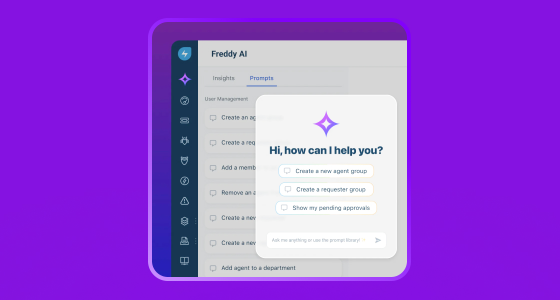
Freshservice is one of the platforms taking that direction seriously. Freddy AI now operates across the change lifecycle, not as a separate add-on, but as a layer woven into approvals, risk assessment, CMDB context, and post-implementation review. For IT leaders evaluating how to modernize change management without rebuilding their service desk, the practical question is what AI actually changes about the day-to-day work, and where it pays off first for the business.
Even mature IT teams hit the same friction points with classical ITIL change processes. Forms get long because nobody trusts the data flowing into them. Change advisory boards meet weekly because schedules cannot accommodate ad-hoc reviews, which means simple changes wait days for low-risk approvals. Risk assessments depend on whoever happens to know the affected service, and when that person is unavailable, the change either stalls or moves forward without a real impact picture.
The cost shows up in two places. The first is velocity: teams ship fewer changes per sprint, and the changes they do ship arrive late, which pushes business initiatives behind their original commitments. The second is incident volume, because changes that bypass real impact assessment cause outages, rollbacks, and emergency changes that absorb capacity the team should be using to improve services. Both costs are visible to the business, even when the underlying cause is invisible to executives.
Artificial intelligence is most useful in change management where there is a repeatable judgment call that humans currently make under time pressure. Categorizing a change as standard, normal, or emergency is one such call. Estimating likely impact based on the affected service, the time window, and the requester's history is another. Recommending the right approvers based on past CAB decisions and the systems involved is a third. Each of these is a pattern recognition task before it is a governance task.
Freshservice approaches AI in change management as augmentation rather than replacement. Freddy AI reads the change record, references previous similar changes, considers asset relationships through the CMDB, and proposes a recommended path forward. Change managers stay in control of the final decision, but the manual work of gathering context, drafting risk language, and triggering the right workflow is significantly reduced. The result is a process that still meets ITIL standards but moves at the pace the business actually expects.
The areas where AI consistently delivers the most value in change management tend to be predictable. They live at the intersection of repeatable judgment and incomplete information, exactly where human reviewers run out of time on a busy afternoon. Knowing where to point Freddy AI first is what separates teams that adopt the technology successfully from teams that treat it as a feature checkbox without integrating it into day-to-day governance:
Risk assessment is the step where change management most often becomes subjective. Teams know that a deployment to production carries more risk than a routine patch, but quantifying that risk in a way the CAB can act on usually depends on whoever drafted the change. Freddy AI Insights brings a data-backed view to that conversation, drawing on the history of similar changes, recent incident clusters, and CMDB relationships to highlight where the real exposure sits in any given window.
The practical benefit is faster, more confident decisions. Instead of debating whether a change is medium or high risk, the CAB sees a recommended risk classification supported by evidence, for example, three related incidents in the same configuration item over the last quarter, or a maintenance window that overlaps with a payroll cycle. Reviewers can override the recommendation, but they start from a defensible position rather than from a blank form on a busy afternoon.
One of the most useful recent additions to Freshservice change management is the ability to run parallel approval chains. The May 2026 update introduced approval groups that allow multiple stakeholders to weigh in at the same time, instead of waiting for a sequential round of email reminders. For changes that touch security, finance, and operations, this single shift can shave days off the cycle without removing any of the oversight that compliance teams require for sensitive systems.
Combined with AI-recommended approvers, the impact is meaningful. The system suggests who should review based on past decisions and impacted services. Approvers receive context-rich requests with risk assessments already populated. Reminders follow automatically when an approval is pending. For change managers, the time spent chasing decisions disappears, and for approvers, the request lands with enough information to act on without scheduling another meeting. Governance stays intact, but the day-to-day experience is dramatically better.
Impact analysis only works when the underlying configuration management database is current, which has historically been the weakest link in ITSM. Freshservice has invested heavily in turning the CMDB into a living model rather than a documentation artifact. Continuous discovery feeds asset relationships in near real time, and AI flags anomalies, orphaned assets, services with missing dependencies, or relationships that look incorrect, so the data stays trustworthy enough for change reviewers to rely on confidently.
For change management, that reliability transforms how teams scope risk. When a change is logged against a service, the linked CMDB context surfaces every downstream system, integration, and business process that could be affected. Reviewers see, before approving, the actual blast radius of the change. Engineers see whether their proposed maintenance window collides with a critical dependency. The conversation moves from intuition to evidence, and that shift is what makes AI-assisted change management defensible to auditors and credible to the business.
Not every change needs a CAB. A meaningful share of IT change volume is repeatable, low-risk, and pre-approved, password policy updates, certificate renewals, scheduled patches, capacity adjustments inside well-understood thresholds. Freshservice workflows let teams automate these standard changes from request to closure, including approvals, scheduling, execution, and verification, without a human routing the ticket between steps and without sacrificing audit visibility along the way.
The benefit compounds quickly. Engineers stop spending time shepherding routine work through change tickets, and CAB members focus only on the changes that actually need their judgment. Service desk metrics improve because routine changes no longer pile up in queues, and audit logs remain complete because every automated step is recorded with timestamps and context. AI assists by recommending which change types are good candidates for full automation based on historical success rates and rollback frequency.
The teams getting the most out of AI-assisted change management in Freshservice tend to share a few characteristics. They treat the CMDB as a product, not a one-time project. They invest in clear change categories so AI has a reliable taxonomy to learn from. They review Freddy's recommendations regularly, accepting the good ones and flagging the wrong ones so the model continues to improve. The result is a change practice that genuinely accelerates over time rather than plateauing.
The early signals show up in metrics that matter to IT leadership. Mean time to approve drops because parallel approval chains and AI-recommended approvers remove the queuing delay. Change failure rate drops because risk classification is more accurate and impact analysis is more complete. Emergency changes drop because more changes are caught before they cause incidents, and audit preparation time drops because the trail is automatic. Each of these is a board-level number, and AI is the lever that moves them together.
AI-powered change management does not arrive by flipping a switch. It depends on a configured Freshservice instance, a healthy CMDB, well-defined change categories, and workflows that reflect how your business actually approves work. Most IT teams have some of these in place and gaps in others, which is where a structured implementation plan saves months of trial and error and protects the value of the platform investment your organization has already committed to.
GB Advisors works with IT and ITSM leaders to design Freshservice change management implementations that scale,. from initial CMDB modeling to AI-assisted risk policies to automation of standard changes, and to evolve them as new Freddy capabilities ship. If your team is evaluating how to bring AI into change management without disrupting governance, a focused conversation about your current state and goals is the right next step toward measurable improvement.