HaloCRM and the Hidden Cost of a Broken Lifecycle
May 26, 2026
Most revenue leaders can describe their sales pipeline in painful detail — but ask them to map the entire customer lifecycle, from the first marketing touch to the latest renewal conversation, and the picture gets fuzzy fast. Touchpoints get logged in different systems, ownership shifts mid-journey, and visibility quietly degrades each time a customer crosses an internal boundary.
That is where the hidden cost lives. It is not a single line item on a spreadsheet, which is exactly why it survives. It hides inside missed renewals, slower deal cycles, and friction that customers no longer mention because they have already started shopping for a competitor. By the time the impact becomes visible in the numbers, the company has already paid for it many times over.
This article unpacks what that hidden cost actually looks like, why traditional CRMs make it worse, and how a unified platform like HaloCRM closes the gaps that fragmentation creates across sales, service, and customer success.
Customer lifecycle control is the ability to see, influence, and measure every stage a customer moves through — awareness, consideration, purchase, onboarding, support, expansion, and renewal — from a single source of truth. It is not a technology feature. It is an operating capability that depends on data, process, and tools working together.
When a company has lifecycle control, three things become possible. Anyone in the business can answer "What is happening with this account right now?" without making three calls. Marketing, sales, service, and customer success all act on the same definition of a healthy customer. And the company can reliably attribute revenue, churn, and expansion back to the actions that produced them.
When that control breaks, the symptoms are familiar: handoffs that drop context, support tickets that surprise account managers, and marketing campaigns aimed at customers who already complained about the same issue last week. The lifecycle keeps moving, but no one is steering it.
The most expensive consequence of a fractured lifecycle is the cost you cannot see in any one report. It accumulates across many small failures, each of which feels like a normal day at work.
None of these line items appear in a board deck labeled "fragmentation tax." Instead they show up as soft revenue misses, longer ramp times, and an operations team that spends most of its hours stitching reports together by hand. Industry analysts consistently find that data fragmentation is one of the top drains on enterprise productivity, and the cost compounds the longer it goes unaddressed.
Most CRMs were designed for one job: tracking sales opportunities. That heritage still shapes how they treat the rest of the lifecycle. Service tickets sit in a separate tool. Marketing automation has its own contact records. Customer success teams build their own spreadsheets because the CRM does not capture the signals they care about.
The result is a CRM that looks comprehensive in a demo and feels disconnected in production. Reports require exports. Account 360 views are 360 only inside the boundary of one department. Integrations bridge the gaps, but every integration is a place where data drifts, mappings break, and the lifecycle picture loses fidelity.
Worse, the cost of those disconnections falls on the customer. They feel it the moment a service agent does not know about the active expansion conversation, or a sales rep follows up with a renewal pitch the day after a critical outage was finally resolved. The customer does not see your tools. They only see whether you act like one company or several.
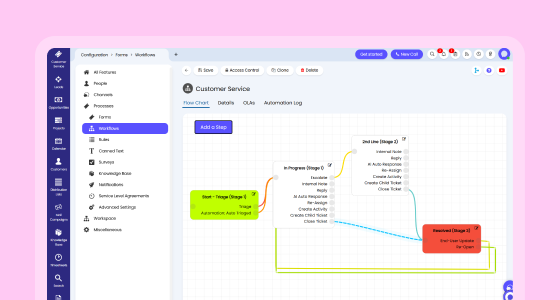
HaloCRM takes a different starting point. Instead of bolting service onto a sales CRM or sales onto a service desk, it unifies them on a single data model designed for the full lifecycle. Sales pipeline, service history, customer communications, and contracts all live next to each other on one record.
That architecture changes what teams can do day to day:
HaloCRM brings every customer channel — email, chat, phone, social, and web — into one workspace, so context travels with the customer instead of being trapped in whichever tool first received the message. Sales pipelines, deals, and weighted forecasts run on the same record set as service interactions, which means a question like "Are we at risk of losing this account?" finally has one place to ask it.
Unifying the data is the foundation. The leverage comes from what you do with it. HaloCRM embeds AI throughout the platform, turning the unified record into a stream of decisions instead of a passive history.
Lead scoring identifies the opportunities most likely to close, drawing on signals from across the lifecycle, not only marketing fit data. Suggested replies help agents respond faster with consistent answers. Virtual agents handle routine queries around the clock so humans focus on the conversations that move revenue. Report analysis flags trends and at-risk customers that would have been buried in raw data.
The most important shift AI enables is the move from reactive to proactive. A unified, AI-augmented lifecycle does not wait for a customer to escalate. It surfaces the signal — declining usage, slowed engagement, a string of tickets on the same topic — early enough for a human to intervene with the right message at the right moment. That is where the hidden cost finally becomes a recoverable opportunity.
Lifecycle control also changes what you measure. Activity metrics — calls made, tickets closed, emails sent — are useful, but they describe motion rather than results. With a unified system, leaders can step up to outcome metrics that reflect the real health of the customer base.
These metrics only work when the underlying data is consistent. Trying to calculate net retention from three disconnected systems is not measurement — it is reconciliation. HaloCRM removes that reconciliation step so leadership can stop debating numbers and start acting on them.
Most companies cannot rip and replace every customer system at once, and they should not try. The path to lifecycle control is staged, and the first stages can deliver value within a quarter.
Start by mapping the lifecycle as it actually runs today, not as the org chart describes it. Identify the handoffs where context is most often lost — usually between marketing and sales, between sales and service, and between service and customer success. Each of those handoffs is where fragmentation costs you the most.
Bring sales, service, and account data onto a single platform. With HaloCRM, this is the foundation everything else builds on, because every later improvement assumes one trusted record per customer.
Layer in AI-driven lead scoring, churn risk indicators, and routing rules so the system actively flags what needs attention rather than waiting for someone to notice.
Move leadership reviews from activity dashboards to outcome dashboards. This is where culture catches up to capability and the lifecycle becomes the unit of management.
The hidden cost of a broken customer lifecycle does not announce itself. It surfaces in the deal that almost closed, the customer who quietly left, the report that took a week to assemble. None of those moments look like a crisis on their own — which is exactly why fragmentation persists.
Closing the gap starts with one decision: treat the customer lifecycle as the system that actually runs the business, and build your tooling around it. HaloCRM is designed for exactly that shift, replacing the patchwork of sales, service, and success tools with one platform that gives every team the same view of every customer.
If you would like to see how this works for your own lifecycle data, the HaloCRM solution overview is the best place to start, or you can talk with a GB Advisors specialist about your current stack.