How to Configure SLAs by Channel in Freshdesk Omni
September 1, 2026
Most support teams treat their SLA dashboard the way a smoke detector treats a fire: it tells you something has already gone wrong. By the time a ticket shows red, the customer has been waiting long enough to notice, and the agent working it is already behind on the next three tickets in the queue. That pattern repeats itself daily in teams that use SLAs purely as a compliance number rather than a management tool.
Freshdesk Omni gives support leaders the configuration options to change that pattern, but most teams never move past the default setup: one resolution target, one first-response target, applied the same way to every ticket regardless of channel, customer, or issue type. That default treats every request as equally urgent, which means none of them actually get treated as urgent. The result is a team that spends its day reacting to whichever ticket is closest to breach rather than working the queue by actual business impact.
This article walks through how to configure SLAs in Freshdesk Omni by channel, customer segment, and issue type, and how early-warning escalation rules change agent behavior before a breach happens rather than after. The goal is a support operation that manages itself proactively instead of one where the SLA report is simply a record of what already went wrong.
Ask most agents what an SLA is for, and they will describe it as the thing that gets flagged in their performance review when they miss it. That perception is not unfair. Many support organizations only look at SLA data after a breach, in a weekly report that lists who missed what, which turns a scheduling and workload tool into a disciplinary one. When SLAs only appear in conversations about failure, agents learn to manage the metric defensively, closing tickets quickly to avoid a breach rather than resolving the underlying issue thoroughly.
The fix is not to lower the targets or remove the metric. It is to change when the team sees the data. A support manager who reviews SLA status only after tickets breach is managing history. A support manager who reviews tickets approaching their SLA threshold, several hours before the deadline, is managing the day. Freshdesk Omni supports both views, but only the second one changes outcomes, because it gives agents and supervisors time to act while there is still time to act.
Reactive and predictive SLA management use the same underlying targets, first-response and resolution times, but they differ in when the organization looks at the data and what it does with what it sees. That difference in timing is not a minor implementation detail; it determines whether the metric helps a team manage the day ahead or only explains, after the fact, why the day already went wrong.
A reactive SLA setup measures compliance after the fact: what percentage of tickets met their first-response and resolution targets over a given period. It is useful for reporting to leadership and for identifying long-term trends, but it does nothing to change the outcome of the tickets already in the queue, because by the time the report runs, those tickets are already resolved or already breached.
Predictive SLA management adds a second layer: time-based triggers that fire while a ticket still has time left on the clock, not after it runs out. In Freshdesk Omni, these triggers can alert an agent when a ticket reaches 75 percent of its SLA window, escalate to a supervisor at 90 percent, and reassign automatically if no action follows. This is the mechanical foundation of genuinely proactive customer support, because it converts a lagging compliance number into a real-time signal the team can still act on.
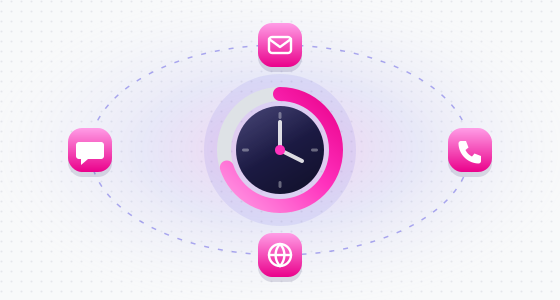
Not every channel carries the same urgency, and a single SLA policy applied across email, chat, phone, and social media will always be wrong for at least one of them. A customer on live chat expects a response in minutes; the same customer emailing a detailed technical question can reasonably wait hours. Freshdesk Omni allows separate SLA policies per channel, which means:
Configuring channels separately does not add meaningful administrative overhead once the policies exist, since each policy only needs to be set up once and then runs on its own. What it does remove is the daily friction of agents constantly overriding a one-size-fits-all target that was wrong for the channel in the first place, and the manual judgment calls that overriding requires from every agent, every shift.
Beyond channel, the customer's own tier or contract terms often justify a different SLA entirely. Enterprise accounts with contractual support commitments need policies that match those commitments exactly, while free-tier or trial users can reasonably sit on a slower track without damaging a paying relationship. Freshdesk Omni's segmentation applies SLA policies based on ticket properties like company, contact type, or a custom field marking account tier, so the distinction does not depend on an agent remembering who the customer is. This segmentation pairs naturally with personalized customer responses, since the same ticket properties that trigger a faster SLA can also surface the account context an agent needs to respond appropriately without digging through a separate system first.
The third axis is the nature of the request itself. A password reset and a service outage should never share an SLA policy, even if they arrive through the same channel from the same customer tier. Freshdesk Omni lets policies key off ticket type and priority fields, which supports a structure like:
This layered approach means a single customer can experience different SLAs across their own open tickets, which is appropriate, because their tickets are not equally urgent to them either. A customer with an outage ticket and a minor feature request open at the same time does not expect, or want, both to move at the same speed, and treating them identically would waste urgency on the request that does not need it.
Escalation rules are where predictive SLA management actually changes daily behavior rather than just reporting on it after the fact. A well-built escalation path notifies the assigned agent first, then a team lead if no action follows within a defined window, then a manager if the ticket is still untouched as it approaches breach. Each step should carry enough context that the person receiving the alert can act immediately rather than needing to investigate the ticket from scratch. Freshdesk Omni can trigger these alerts inside the platform, over email, or through chat integrations the team already uses daily, which keeps the warning inside the tools people are already watching instead of adding one more dashboard nobody checks until it is too late.
Once channel, segment, and priority-based SLAs are live, the reporting question changes from "did we hit the target" to "where is the target still wrong." Freshdesk Omni's reporting can break SLA performance down by each of these dimensions, which turns what used to be a single number into a genuine efficiency gap analysis that shows exactly which channel, segment, or issue type is consistently under strain. That level of detail is what lets a support leader adjust staffing or policy before the next quarter's numbers repeat the same pattern, rather than discovering the same bottleneck for the third time in a row.
Getting SLAs right is less about tightening the targets and more about giving the team a reason to look at them before they break. A support organization that only reviews SLA data in a post-mortem will keep firefighting no matter how the targets are set, while one that builds early warnings into the daily workflow turns the same metric into the tool it was always meant to be. Teams weighing how to restructure their SLA policies without disrupting an already busy queue often find it useful to walk through the configuration with a partner who has done this rollout before.