Customer Service Management: Why Channel-Switching Is Costing You Customers
August 5, 2026
A customer messages your support team on WhatsApp about a billing issue. Nobody responds fast enough, so she calls instead. The phone agent has no idea the WhatsApp conversation ever happened, so she explains the whole problem again from scratch. Frustrated, she emails a follow-up an hour later, and a third agent picks it up with zero context, again. By the time the issue actually gets resolved, she's repeated herself three times to three different people who each thought they were starting fresh. The problem itself wasn't complicated. What made it painful was that the company's systems couldn't remember a conversation it was already having.
This scenario plays out constantly, in every industry, at companies that would never think of themselves as having bad customer service. The support agents are courteous, the resolution eventually happens, and the ticket gets closed. But the customer experience was still worse than it needed to be, because the underlying systems treated each channel as a separate conversation instead of one continuous relationship. That gap has a name in the industry, and it's exactly what customer service management, done properly, is supposed to close.
Customer service management isn't a single feature or a single tool. It's the discipline of coordinating every channel a customer might use to reach a company, every case those interactions generate, and every agent who touches that case, into one coherent system instead of a pile of disconnected point tools. It covers omnichannel ticketing, service level agreement tracking, case routing, agent workload distribution, and the analytics that tell a company whether any of that is actually working.
The term matters because it's easy to conflate customer service management with any one of its parts. A live chat widget is not customer service management. A shared inbox is not customer service management. Even a capable help desk ticketing tool, on its own, isn't customer service management if it only handles one channel well and leaves the rest fragmented. The full discipline is what happens when all of those pieces are unified enough that an agent picking up a case has the complete history in front of them, regardless of which channel the customer originally used.
The gap between doing this well and doing it poorly isn't subtle. Omnichannel support that genuinely unifies context across channels achieves 67% customer satisfaction, compared to just 28% for disconnected multichannel systems that technically offer multiple channels but don't connect them behind the scenes. That's a 39-point gap, and it's driven almost entirely by whether context transfers with the customer or gets lost every time they switch channels.
The retention numbers tell an even sharper version of the same story. Companies with strong omnichannel strategies retain 89% of their customers, compared to just 33% for companies with weak strategies. That's not a small optimization. That's the difference between a customer base that mostly stays and a customer base that mostly leaves, and the deciding factor is whether support channels are actually connected to each other or just installed side by side.
Part of what makes disconnected channels so costly right now is that customer expectations have moved faster than a lot of companies' underlying systems. Seventy-two percent of customers expect a response within 30 minutes of reaching out, and expectations vary sharply by channel: 47% expect a response within four hours, while 12% expect a response within 15 minutes. According to a 2026 Gartner report, 91% of customer service leaders say customer expectations have increased year over year — not held steady, increased, meaning the systems that were adequate two years ago are falling further behind every year they aren't upgraded.
Channel performance itself varies enormously too, which matters for where a company should focus first. Live chat leads satisfaction benchmarks at 87% CSAT, because customers resolve transactional issues without hold-time frustration. Email trails well behind at 61% CSAT. A company that's only measuring overall satisfaction without breaking it down by channel is missing exactly the kind of gap that customer service management is built to close.
The customer-facing cost of disconnected systems gets most of the attention, but there's an equally serious cost on the agent side that rarely makes it into the conversation. Seventy-four percent of call center workers experience burnout at some point in their careers, and 63% currently report high burnout levels. Separately, 77% of customer service reps say their workload and the complexity of customer issues have increased compared to a year ago — meaning the job isn't just busier, it's also harder, with less time per case to work with.
The downstream effect of that burnout is measurable and expensive. Fifty-three percent of high-stress agents say they're likely to leave within six months, and average annual turnover in call centers runs 30 to 45%, with peaks as high as 60% in some organizations. Each agent replacement costs somewhere between $10,000 and $20,000 once hiring, training, and ramp-up time are accounted for. A company running ten support agents at the high end of that turnover range is looking at replacing four to six people a year, at a cost that easily runs into six figures, before counting the service quality dip every new hire causes while they're still learning the systems.
None of this is really about individual agents not being resilient enough. It's what happens structurally when agents are handling more complex cases, with more channels to monitor, and no unified system helping them see the full picture before they respond. Disconnected systems don't just frustrate customers, they quietly grind down the people trying to help them.
There's a specific mechanism worth naming here: every time an agent has to reconstruct context that already exists somewhere in the system, that's unpaid cognitive labor stacked on top of the actual work of resolving the customer's issue. A case that should take three minutes to resolve stretches to eight or ten once an agent has to piece together what happened on a different channel, guess at what's already been tried, and ask the customer to fill in gaps that a unified system would have surfaced automatically. Multiply that extra five to seven minutes across dozens of cases a day, and the same team handling the same ticket volume ends up working meaningfully longer hours, or leaving a meaningfully larger backlog, for reasons that have nothing to do with the actual difficulty of the underlying issues.
Service level agreements exist to set a clear, measurable promise about how quickly and how well a company will respond to a customer issue. But SLA compliance isn't primarily a matter of agents trying harder. Research on ticket prioritization consistently shows that SLA compliance improves during workload peaks, abandonment rates fall, and agent satisfaction scores typically improve specifically when workloads are distributed consistently rather than left to pile up unevenly across channels or shifts.
That's a structural finding, not a motivational one. A support operation where tickets from five different channels land in five different queues, monitored inconsistently by whichever agent happens to be free, has no real way to guarantee SLA compliance no matter how committed the team is. A support operation where every channel feeds into one prioritized, visible queue can actually enforce the SLA it promised, because the system is built to make workload visible and balanced rather than requiring each agent to somehow track five separate inboxes in their head.
Given all of this, the shape of a customer service management system that actually works starts to look pretty specific. It needs to ingest inquiries from every channel a customer might reasonably use, voice, chat, email, web forms, and social media, into one system rather than five. It needs to preserve full context when a customer or an agent switches channels mid-conversation, so nobody has to start over. It needs SLA tracking that's visible and automatic, not something an individual agent has to remember to check. And it needs reporting that breaks performance down by channel, not just as one blended average that hides which channels are actually underperforming.
None of this requires reinventing customer service as a concept. It requires building — or adopting — the infrastructure that lets a company's existing service intentions actually reach customers consistently, regardless of which door they happened to walk through.
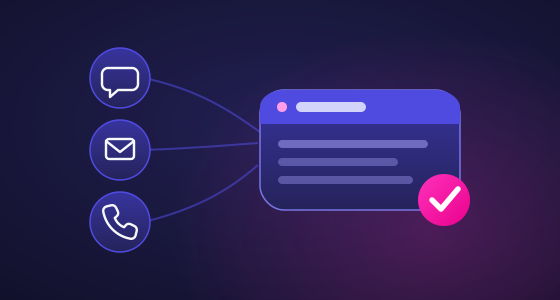
HaloCRM's approach to customer service management starts from the same observation driving this whole piece: a customer's inquiry is one continuous conversation, even if it touches five different channels along the way, and the system has to be built around that reality rather than around each channel separately. The platform ingests customer enquiries from voice, chat, email, web forms, social media, and more into a single case management system, so a case that starts on WhatsApp and continues by phone stays one case, not three.
Agents can switch channels on the same ticket without losing the thread, which directly closes the exact gap described earlier in this piece: a customer who moves from chat to email to a phone call doesn't have to repeat themselves, because the agent picking up the case sees everything that happened before, on every channel, in one place. This is the practical difference between the 67% CSAT that genuine omnichannel systems achieve and the 28% that disconnected multichannel setups settle for.
This connects directly to a broader pattern already covered in HaloCRM and the Hidden Cost of a Broken Lifecycle, which lays out what happens when sales, service, and customer data live in separate silos across a business: the same fragmentation that breaks a customer's journey between departments is exactly what breaks it between support channels, and HaloCRM's underlying approach — unify the data, unify the view — addresses both problems with the same architecture rather than treating them as separate projects.
AI plays a role here too, but a narrower and more concrete one than the sales-automation angle covered in What an AI Agent Actually Does in a B2B CRM and HaloCRM AI Agents: Automating Sales and Customer Workflows. On the service side specifically, AI-assisted resolution helps triage and route incoming cases, suggests responses agents can accept or edit rather than write from scratch, and handles the repetitive first-pass work that contributes heavily to the workload complexity driving agent burnout. It's worth being direct about what this isn't: it's not replacing agents on complex or emotionally sensitive cases, it's removing enough of the repetitive load that the agents who remain aren't drowning in it.
SLA management is built into the same system rather than bolted on separately, which means the workload-distribution research described earlier — SLA compliance improving when work is spread evenly rather than piling up unpredictably — has an actual mechanism behind it: cases are visible, prioritized, and routed automatically rather than depending on which agent happens to notice a queue building up.
There's a benefit to unifying customer service management that goes beyond fixing the immediate frustration of repeated conversations: once every channel feeds into one system, the resulting data becomes something leadership can actually act on, rather than a set of disconnected reports that each tell a partial story. A support leader who can see, in one place, which channels are generating the most repeat contacts, which case types are consistently blowing past SLA targets, and which agents are handling disproportionate case complexity, is working with a genuinely different quality of information than one piecing together five separate exports and trying to reconcile them by hand.
This matters most for the kinds of decisions that actually move the needle: staffing the right channels at the right times, identifying a recurring product or billing issue before it generates hundreds of near-identical tickets, and knowing which parts of the customer journey are quietly costing the company retention before the churn numbers make it obvious. A support operation that can only report on volume and average resolution time is flying with limited instruments. One where every channel, case, and agent interaction feeds a single reporting layer is working with the full picture.
Customer service management carries a distinctly regional shape across Latin America, and treating it as a generic, one-size-fits-all discipline misses some of the sharpest data on the subject. WhatsApp isn't a secondary channel in the region, it's often the primary one: the WhatsApp Business API lets companies connect multiple agents, build chatbots, automate transactional notifications, run segmented campaigns, and scale support without losing the personal feel that made the channel popular with customers in the first place.
Regional research also shows that resolving a problem quickly is now 1.8 times more important to Latin American consumers than speaking directly with a person — a meaningful shift away from the assumption that customers in the region primarily want a warm, human conversation regardless of speed. At the same time, 80% of consumers in the region report frustration when they have to repeat the same information every time they interact with a new agent or switch channels, which is precisely the failure mode described at the start of this piece, playing out at regional scale. Omnichannel platforms that unify WhatsApp, voice, email, live chat, and Instagram into a single view have been shown to generate engagement improvements of roughly 50% compared to fragmented setups, according to industry research on the region.
Put together, this means a customer service management system built for Latin America specifically needs WhatsApp treated as a first-class channel, not an afterthought bolted onto a system designed around email and phone, and it needs the same context-preservation discipline described earlier applied just as rigorously to WhatsApp-to-voice or WhatsApp-to-email handoffs as to any other channel combination.
Picture two versions of the same billing dispute at a company handling support across several countries.
In the disconnected version, a customer messages on WhatsApp, gets no timely response, and calls instead. The phone agent has no record of the WhatsApp conversation, so the customer explains the issue again from the beginning. The case gets escalated, and a third agent picks it up by email with no visibility into either prior interaction, asking the customer to explain everything a third time. The issue eventually gets resolved, but the customer has now spent three times the effort it should have taken, and walked away with a clear sense that the company's teams don't talk to each other.
In the connected version, the same customer's WhatsApp message becomes a case the moment it's sent. When the customer calls instead, the phone agent sees the full WhatsApp thread before picking up, already has the context, and can either resolve it immediately or note next steps directly on the case. If it needs to escalate, the next agent inherits the complete history automatically, not a fresh blank ticket. The customer explains the issue exactly once. Nothing about the underlying billing problem was different between these two scenarios — what changed was whether the system was built to remember a conversation it was already having.
Before assuming your current setup is adequate because no one's complained loudly yet, run it through a few honest questions.
If more than one of these answers is uncomfortable, the disconnected-channel cost described in this piece is very likely already showing up in your CSAT scores, your agent turnover, or your customer retention numbers, whether or not anyone has traced it back to this specific gap yet.
Isn't this really just about buying more support software? Software is part of it, but the harder part is making sure whatever software you have actually unifies channels instead of just adding another one. A company can own five separate tools and still have a completely disconnected customer experience if none of them talk to each other.
Won't switching to a unified system disrupt agents who are used to their current tools? A transition has a real cost, but so does every day spent under the current fragmentation, in the form of avoidable agent burnout, repeated-explanation frustration, and CSAT scores sitting well below what omnichannel systems demonstrably achieve. The comparison that matters is a bounded transition cost against an ongoing, compounding one.
Is this only relevant for large enterprise support operations? The underlying mechanics apply at smaller scale too. A twenty-agent support team handling three channels has the same context-loss problem a two-hundred-agent team has, just at a smaller volume — and the fix, unifying those channels into one case view, closes the gap just as effectively regardless of size.
How is this different from just training agents to ask better follow-up questions? Better training helps at the margins, but it can't fix a structural problem: an agent who genuinely has no record of a prior conversation cannot ask an informed follow-up question about it, no matter how well trained they are. The fix has to happen at the system level, not just the individual-skill level.
Doesn't adding AI-assisted resolution risk making support feel impersonal? The evidence points the other way when it's implemented as described here: AI handling repetitive first-pass triage and drafting frees agents to spend their attention on the parts of a case that actually need human judgment, rather than burning that attention reconstructing context a system should have preserved automatically. Customers consistently report higher satisfaction with faster, well-informed human responses than with slower ones, regardless of how much automation happened before the human got involved.
Customer service management isn't failing at most companies because agents don't care about customers. It's failing because the systems underneath those agents were often built one channel at a time, without anyone stepping back to unify them into a single coherent view of each customer relationship. The gap between omnichannel systems that actually connect and multichannel setups that just multiply disconnected inboxes shows up in CSAT scores 39 points apart, in retention rates nearly three times higher for the companies that get it right, and in agent burnout numbers that quietly cost six figures a year in turnover alone.
If you want to see what customer service management actually looks like when every channel is genuinely unified into one system, book a conversation with our team. We'll walk through your current setup and show you exactly where disconnected channels are most likely costing you customers, agents, or both today.