HaloCRM AI Agents: Automating Sales and Customer Workflows
June 24, 2026
Sales teams have always struggled with a fundamental tension: the activities that drive revenue — building relationships, understanding customer needs, having meaningful conversations — are exactly the activities most easily crowded out by administrative work. Data entry, follow-up scheduling, lead status updates, pipeline reports — these tasks are necessary, but they consume hours that could go toward actual selling. For sales leaders trying to maximize output from a fixed team, that tradeoff is a constant source of frustration.
AI agents inside CRM platforms are changing that equation. Unlike the rule-based automations that CRM tools have offered for years, modern AI agents are goal-oriented and autonomous — they can reason about a situation, decide on an action, and execute it without waiting for a human to trigger each step. Research into agentic AI in sales contexts suggests that organizations deploying AI agents effectively automate up to 70% of routine CRM workflows, including lead qualification, follow-up scheduling, customer inquiry responses, and deal risk monitoring. Teams consistently report meaningful time savings and improved conversion rates within sixty days of deployment.
HaloCRM, the customer relationship management platform from Halo Service Solutions, is built with this kind of intelligent automation at its core. From virtual agents that handle customer self-service to AI-powered suggestion engines that assist human agents in real time, HaloCRM gives sales and customer service teams the tools to operate more efficiently without sacrificing the quality of customer interactions. This article breaks down what those capabilities look like in practice and how organizations are using them to build faster, more consistent customer workflows.
The term “AI agent” is used broadly enough that it is worth being precise. In the context of CRM, a true AI agent is not simply a chatbot that answers questions from a fixed script, nor is it a basic automation that fires an email when a lead reaches a certain status. An AI agent is a system that perceives its environment — in this case, the data inside the CRM — sets or receives a goal, reasons about how to achieve it, and takes action autonomously. The key characteristic is autonomy: the agent acts without requiring a human to trigger each individual step.
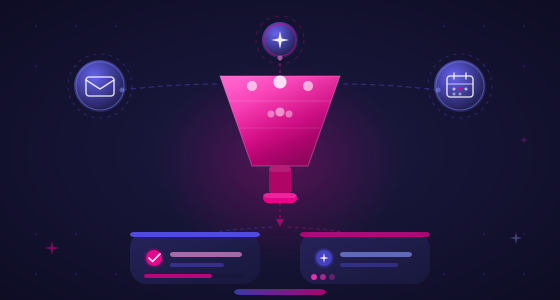
Applied to sales and customer service, this means AI agents can manage entire workflows end to end. A lead qualification agent, for example, can review a new contact record, assess fit against defined criteria, research the prospect's company, draft an initial outreach message, schedule a follow-up, and update the pipeline record — all without a sales representative doing anything beyond reviewing the output. A customer service agent can receive an inquiry, check the customer's history, retrieve the relevant policy or product information, draft a response, and escalate to a human agent only if the complexity of the request warrants it.
The practical impact is a significant compression of cycle times. Tasks that took a sales rep thirty minutes to complete manually — researching a prospect, personalizing an outreach, logging the activity — happen in seconds when an AI agent handles the workflow. This is not about replacing the sales team; it is about removing the administrative layer that sits between the team and meaningful customer engagement. The shift changes what salespeople spend their time on, which in turn changes what the pipeline looks like.
HaloCRM approaches AI-powered automation through several distinct but complementary capabilities. At the customer-facing layer, the platform's virtual agent handles incoming customer contacts through a self-service portal, providing responses and resolving standard inquiries without routing them to a human agent. At the agent-assistance layer, HaloCRM delivers contextual AI support to human agents as they work — surfacing relevant customer history, open inquiries, suggested responses, and knowledge articles in real time. And at the workflow layer, the platform's automation engine handles repetitive background tasks: acknowledgement emails, ticket escalations, status updates, and SLA enforcement.
These three layers work together to create a CRM environment where AI handles what it is best at — speed, consistency, and data processing at scale — while human agents focus on what they are best at: nuanced conversations, relationship development, and complex problem resolution. The division is practical rather than rigid; the platform is designed to escalate intelligently when a customer contact exceeds the virtual agent's capabilities, passing full context to the human agent so the transition is seamless from the customer's perspective.
HaloCRM's AI capabilities are built on an omnichannel platform that consolidates customer interactions from email, phone, chat, social media, and self-service into a single interface. This matters for AI agent effectiveness because agents need a complete view of the customer relationship to make good decisions. An AI agent that can only see one channel is working with incomplete information; one that has the full interaction history across all channels makes significantly better routing, prioritization, and response decisions.
For sales teams, lead qualification is one of the highest-leverage automation targets. The process of reviewing incoming leads, assessing fit, prioritizing outreach, and scheduling follow-up is time-consuming when done manually and highly consistent in its logic — which makes it well suited to AI agent execution. HaloCRM's automation engine allows sales operations teams to define qualification criteria, routing rules, and follow-up sequences that execute automatically as leads enter the system.
A lead that meets defined criteria — company size, industry, geography, product interest — gets routed to the appropriate sales representative, tagged with the relevant sequence, and triggeres the first touchpoint automatically. A lead that does not meet the criteria gets routed to a nurture workflow rather than consuming a representative's attention prematurely. This filtering function alone saves significant time in organizations that receive high volumes of inbound leads from multiple sources.
Follow-up automation is where the consistency advantage becomes most visible. Research consistently shows that response time is one of the strongest predictors of lead conversion — yet manual follow-up depends entirely on individual representative behavior, which varies. Automated follow-up sequences in HaloCRM execute on the same schedule for every lead, removing variability and ensuring no prospect falls through the cracks because a representative was on vacation or had a busy week.
HaloCRM's virtual agent functions as the first point of contact for customer inquiries that arrive through the self-service portal. Rather than routing every contact immediately to a human representative, the virtual agent evaluates the inquiry, searches the knowledge base for relevant information, and provides a response directly to the customer. For standard inquiries — order status, policy questions, basic troubleshooting, account information — this means the customer gets an immediate answer without waiting for an available agent.
The knowledge base integration is what makes the virtual agent genuinely useful rather than merely present. HaloCRM automatically suggests relevant knowledge articles to customers as they type their inquiry, giving them the opportunity to self-serve before even submitting a contact. When contacts are submitted, the virtual agent draws on the same knowledge base to construct its responses, ensuring consistency between self-service content and agent responses.
Escalation logic is configurable and critical. The virtual agent is set up with clear criteria for when to transfer a contact to a human agent — inquiry complexity, customer sentiment, account value, or explicit customer request. When escalation occurs, the full conversation history and context transfer to the human agent automatically, so the customer does not have to repeat information they have already provided. This handoff quality is what determines whether customers experience the virtual agent as helpful or as an obstacle.
Not every customer interaction is suitable for full automation. Complex sales conversations, sensitive customer situations, and high-value account management all benefit from human judgment. HaloCRM supports these interactions by providing AI-powered assistance to human agents in real time rather than replacing them. As an agent works on a customer contact, the platform surfaces the customer's complete interaction history, their other open inquiries, their account status, and — critically — suggested responses based on the content of the current inquiry.
These suggested responses, called canned text in the platform's terminology, are not generic templates. They are rich-text responses that include text, images, and tables, automatically suggested based on the nature of the inquiry being handled. For the most common inquiry types, agents can review a suggested response, adjust it if needed, and send it in a fraction of the time it would take to draft from scratch. For less common inquiries, the suggestion serves as a starting point that speeds the drafting process rather than replacing it entirely.
The cumulative effect of real-time AI assistance is a measurable reduction in average handle time without a corresponding reduction in response quality. Agents who have the right information and a strong suggested response in front of them are faster and more consistent than agents working from memory and blank text fields. Over time, as the suggestion engine learns from the responses agents actually send, the quality of suggestions improves further.
The value of AI agent deployment in HaloCRM is measurable through the platform's built-in reporting capabilities. With over 100 out-of-the-box reports and real-time dashboards, sales leaders and customer service managers have access to the metrics needed to evaluate AI agent performance and identify where additional automation or knowledge base development would have the most impact.
Key metrics to track include virtual agent containment rate — the percentage of customer contacts resolved without escalation to a human agent — average handle time for human agents, lead response time by channel, follow-up completion rates, and SLA compliance across the customer service queue. These metrics provide the data needed to distinguish between automation that is working and automation that needs refinement. A containment rate that is lower than expected, for example, may indicate gaps in the knowledge base rather than a fundamental limitation of the virtual agent.
The reporting infrastructure also supports integration with external tools. HaloCRM's integration with PowerBI and other reporting platforms allows organizations to incorporate CRM performance data into broader business intelligence dashboards, giving leadership a unified view of customer relationship metrics alongside financial and operational data. For revenue operations teams that need to present CRM ROI to executive stakeholders, this level of reporting accessibility is a practical necessity.
If your organization is ready to explore how HaloCRM's AI agent capabilities can accelerate sales cycles and improve customer service efficiency, the GB Advisors team is available to help you assess your current workflows, identify the highest-impact automation opportunities, and design a deployment plan that fits your team's specific environment and goals.