Internal Communication App vs. Intranet: Which Fits?
July 16, 2026
HR and people-ops leaders often inherit a decision that was made years earlier, sometimes before they even joined the company: buy an intranet, roll it out, and hope employees log in on their own. That original purchase can work fine for a while, but as headcount grows past a certain point, or as the workforce shifts toward frontline, remote, or deskless roles, the cracks start to show. Adoption drops, IT keeps fielding requests to update a static page, and employees quietly move important conversations into personal WhatsApp groups instead.
The real question isn't which platform has the longest feature list. It's which communication model actually matches how your specific workforce works day to day. A finance team of forty people sitting at desks has completely different needs than a logistics company with three thousand employees split across warehouses, delivery routes, and a small headquarters team. Treating both scenarios as the same buying decision is where most internal communication projects go wrong from the start.
This article breaks down what an intranet is actually built to solve, what a modern internal communication app adds on top of that, and how company size and workforce type should shape the decision. Along the way, we'll look at where a unified employee experience platform like Humand fits into that framework, since it was built specifically to bridge the gap between traditional intranets and the always-on, mobile-first expectations of today's teams.
A traditional intranet functions as a structured, searchable front door to corporate content: policies, forms, how-to guides, company news, and links to other internal systems. It is fundamentally a "pull" tool — employees go there when they need something specific, rather than being proactively reached. For office-based teams who log into a computer every morning, that model works reasonably well because checking the intranet becomes part of the daily routine.
The limitation shows up with any employee who doesn't sit at a desk. If people don't have a company email address, a workstation, or dedicated browsing time, an intranet effectively doesn't exist for them. It also tends to age poorly: content becomes stale, navigation gets cluttered as more departments add their own sections, and search quality degrades. Many organizations discover their intranet has quietly become a graveyard of outdated PDFs that nobody trusts enough to use as a source of truth.
Internal communication apps were built around the opposite assumption: information should be pushed to people, wherever they are, on the device they already carry. Instead of a static repository, the experience centers on a live feed, direct messaging, @mentions, polls, and real-time acknowledgment of who has actually seen an announcement. That shift from "available if you look" to "delivered directly to you" is the single biggest functional difference between the two categories.
This model also tends to fold in adjacent HR workflows — leave requests, recognition, onboarding checklists, and document sign-off — so employees have one place to both receive information and take action on it. For organizations with distributed or shift-based teams, that consolidation matters more than any individual feature, because it removes the friction of switching between five different systems just to complete one simple task.
Under roughly 100 employees, informal channels like a shared chat app or email often cover communication needs well enough, and a heavyweight platform can be overkill. The tipping point usually arrives when leadership can no longer be confident that everyone received an important message, or when onboarding starts eating up disproportionate management time as headcount climbs past that threshold.
Between roughly 100 and 1,000 employees, the case for a dedicated platform strengthens considerably. Departments multiply, managers can't personally relay every update, and HR needs visibility into whether communications actually reached people rather than assuming they did. This is typically when companies formally evaluate intranet and internal comms tools side by side for the first time.
Above 1,000 employees, especially across multiple locations or countries, the requirements shift again toward permissions, multi-language support, integration with existing HR systems, and detailed reporting on reach and engagement. A well-designed platform at this scale needs to break down silos between departments and locations so that company-wide announcements land consistently, regardless of where an employee is based.
For employees who already spend the day logged into a computer, a browser-based intranet integrated with existing productivity tools can be sufficient, since checking it doesn't require behavior change. The main risk with desk-based teams is not access, but fatigue: another portal competing for attention against email, chat, and whatever project management tool the team already lives in daily.
The calculation changes entirely for retail, manufacturing, healthcare, logistics, and field-service organizations, where a large share of employees may never touch a company computer. Roughly 80% of the global workforce is considered deskless, yet most internal communication tools were originally built assuming everyone had a desk and a corporate email inbox. For these teams, a mobile-first app that works on a personal smartphone isn't a nice-to-have; it's the only realistic way to reach people at all.
Organizations with a mix of office staff, remote employees, and field workers face the hardest version of this problem, because no single channel reaches everyone equally well. These companies typically need a platform flexible enough to serve a desk-based finance team and a delivery driver with the same underlying system, without forcing either group into a workflow designed for the other.
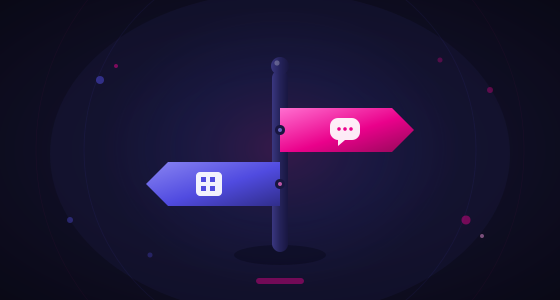
Rather than treating this as a binary choice, many HR and IT leaders land on a complementary approach: a structured hub for employees to find things when they need them, paired with proactive messaging for what employees need to know immediately. Framed simply, one side handles pull and the other handles push, and mature internal communication strategies deliberately use both rather than betting everything on one model.
Modern platforms increasingly blur this line by combining a searchable knowledge base with a live social feed, direct messaging, and push notifications inside a single mobile app. That convergence is precisely why the "intranet vs. app" framing is starting to feel outdated for organizations built around distributed or deskless teams: the practical decision is no longer either/or, but how much of each function a single platform needs to cover well.
Humand was designed around the deskless-first reality described above, combining internal communication, company culture, HR processes, and employee support inside one mobile application spanning roughly 20 modules, including chat, leave management, goals and OKRs, and attendance tracking. Rather than positioning itself purely as an intranet replacement or purely as a chat tool, it aims to cover both the "pull" and "push" sides of the equation: a social community feed and digital magazine for institutional news sit alongside direct messaging, polls, and recognition tools tied to company values.
For HR leaders managing structured onboarding, that combination has measurable stakes. Organizations that pair a strong onboarding process with tools like Humand report new hires who are significantly more likely to stay through their first year, since information, culture, and support all arrive through the same channel a new employee already checks daily. The platform's AI assistant, Sammy AI, is also being expanded to answer routine employee questions directly using company data, reducing the number of simple queries that land on an already-stretched HR team.
Before comparing vendors or sitting through demos, HR and IT leaders benefit far more from answering a short set of questions honestly about their own organization first, since the answers usually narrow the field before a single sales conversation happens. Skipping this step is exactly how so many teams end up locked into a platform that looks impressive in a demo but never gets adopted by the people who actually need it most.
Answering these honestly, rather than starting from a glossy feature comparison chart handed over by a vendor, tends to point toward the right category of tool far faster than a generic bake-off between two or three similarly priced platforms. In most cases, the answers also reveal whether the organization is really choosing between an intranet and an app, or whether it already needs a single platform built to handle both roles at once.
Choosing between an internal communication app and a traditional intranet isn't really about picking the trendier option. It's about being honest with yourself regarding how your workforce is actually structured today, and where it's headed over the next two or three years. For organizations with a significant deskless, frontline, or distributed population, that honesty usually points toward a mobile-first platform built to unify communication, culture, and HR support in one place. GB Advisors works with HR and IT teams across Latin America and the Caribbean to assess exactly this kind of fit before any implementation begins.