AI Pipeline Automation: HaloCRM for Sales Leaders
May 12, 2026
Sales leaders today are caught in a paradox. Pipeline data has never been more abundant, yet rep productivity has not kept pace. Reps spend a substantial portion of their week on data entry, follow-up scheduling, and stage-by-stage hygiene work that has little to do with selling. That gap between activity and revenue is exactly where AI pipeline automation now delivers measurable returns, and it is reshaping how revenue teams operate in 2026.
For mid-market and enterprise sales organizations, the pressure to do more with leaner teams keeps intensifying. Rising customer acquisition costs, longer buying cycles, and harder-to-reach buyers force sales leaders to scrutinize every step of the pipeline for inefficiency. The right CRM, paired with intelligent automation, no longer just stores deal records. It actively flags risks, prioritizes outreach, and recommends the next best action so reps can spend their time on the conversations that close revenue.
That is the promise behind AI-driven pipeline automation in HaloCRM. Built as a unified platform with AI integrated into every module, HaloCRM helps sales leaders convert their pipeline from a static spreadsheet into a living system that adapts to real buyer behavior. In this article, we break down how HaloCRM's AI capabilities work, where they create the biggest impact for sales leaders and revenue operations teams, and how to evaluate whether a shift is right for your organization.
Most sales organizations underestimate how much revenue leaks out of manual pipeline management. Industry research shows reps spend an average of more than a third of their week on administrative tasks rather than active selling. Updating CRM records, chasing internal approvals, copying data between tools, and writing routine follow-up emails consume hours that could otherwise be spent qualifying leads or advancing late-stage deals. Multiply that loss across a team of fifteen or twenty reps and the cost becomes visible in missed quota and slow ramp times for new hires.
Beyond the time drain, manual pipelines create blind spots that hurt forecasting accuracy. When a rep forgets to log a call, marks a deal at the wrong stage, or fails to update a close date, the entire pipeline picture distorts. Sales leaders end up making forecast commitments based on data that does not match reality. Deal slippage compounds, board updates become defensive, and trust between revenue leadership and finance erodes. AI changes this dynamic by capturing activity automatically and validating stage progression against real buyer signals rather than rep memory.
AI pipeline automation works on three fronts at once. First, it removes the manual tasks that drag rep productivity down — note-taking after calls, contact enrichment, follow-up scheduling, and CRM data entry. Second, it surfaces patterns invisible to a human reviewing one deal at a time, such as silent stalls in late-stage negotiations or unusual engagement drops from a key buying-committee member. Third, it recommends concrete next actions, taking cognitive load off reps who are already juggling dozens of open opportunities at once.
The shift in 2026 is from AI that assists to AI that operates routine workflows on its own. Instead of suggesting a follow-up email, modern systems draft and queue it for one-click approval. Instead of flagging a stalled deal, they trigger a re-engagement sequence and notify the account executive only when human judgment is needed. HaloCRM embodies this evolution by embedding AI directly into lead scoring, virtual agents, suggested replies, and report analysis, so the platform behaves like a sales co-pilot rather than a passive system of record that reps update reluctantly.
Unlike platforms that treat AI as a paid add-on, HaloCRM integrates intelligent features into every module out of the box. Lead scoring continuously evaluates inbound prospects against historical conversion patterns, ranking them so reps know which contacts deserve immediate attention. Suggested replies pre-write responses based on the conversation history and the rep's tone, accelerating outreach without losing personalization. Virtual agents handle inbound queries around the clock, qualifying leads, answering common questions, and booking meetings even when the sales team is offline.
Report analysis is where the platform becomes genuinely strategic. AI scans the full set of open deals, customer health records, and account history to surface trends a sales leader would miss while reviewing dashboards manually. It flags customers showing churn signals, highlights segments where conversion rates are slipping, and alerts revenue ops when pipeline coverage falls below the threshold needed to hit quota. These insights show up before the next forecast call, not after the quarter ends, giving leaders meaningful time to course-correct rather than explain.
HaloCRM's pipeline view uses drag-and-drop deal cards, weighted real-time values, and the ability to run multiple pipelines for different products, regions, or sales motions. Reps see their book of business at a glance, while sales leaders can pivot to forecast totals, win-rate breakdowns, or stage velocity in a single click. The visual layer matters because adoption is the silent killer of CRM investments: a clean, intuitive interface combined with AI-driven defaults dramatically increases the likelihood that reps actually use the system instead of working around it in private spreadsheets and untracked email threads.
Routing the wrong lead to the wrong rep wastes cycles on both sides. HaloCRM's AI-powered lead scoring solves this by classifying each inbound prospect against signals such as firmographic fit, engagement history, source quality, and past conversion patterns from similar accounts. The result is a prioritized queue that tells reps which contacts to call first and which to nurture through automated sequences. Companies using this approach commonly report cutting qualification time roughly in half, freeing senior reps to focus on the opportunities with the highest revenue potential and the shortest path to close.
Routing rules go beyond simple round-robin. AI-aware routing considers rep expertise, current pipeline load, language preference, geographic territory, and recent close rates against similar deal profiles. A rep who consistently wins manufacturing accounts in a specific region gets first pick of leads matching that pattern, while overloaded reps are temporarily skipped to keep response times sharp. The combined effect is faster speed-to-lead, higher conversion at the top of the funnel, and a more equitable distribution of opportunity across the team that supports better retention of top performers.
One of the most valuable applications of AI in pipeline management is identifying deals at risk before they slip. HaloCRM analyzes engagement patterns — email opens, reply timing, meeting cadence, and stakeholder participation — to detect when a deal is losing momentum. A deal that has not advanced in two weeks but shows declining buyer engagement gets flagged automatically, with a recommended action such as scheduling a multi-threaded check-in or sending a tailored value-reinforcement piece. Reps no longer rely on memory or weekly pipeline reviews to catch slipping opportunities before they go cold.
Equally important is the platform's ability to surface accelerators. When a deal shows positive signals — additional decision-makers joining a thread, increased website visits from the buying account, or a sudden spike in proposal page time — HaloCRM nudges the rep to advance the conversation while interest is high. Sales leaders gain visibility into both sides of this risk-and-opportunity equation, which lets them coach individual reps with specific examples drawn from real deal data rather than generic feedback during weekly one-to-ones.
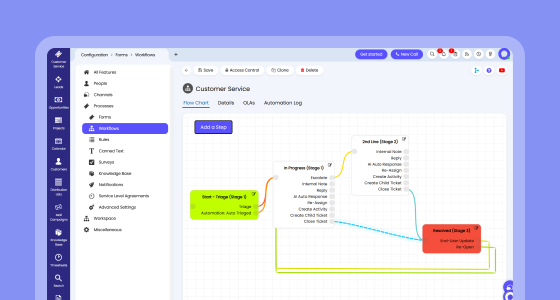
Automation is only useful if non-technical users can build and adjust it without waiting on engineering. HaloCRM includes a visual flowchart builder that combines emails, tasks, conditional branches, and A/B splits into one orchestrated journey. Sequences can be triggered from any object — contact, lead, deal, or ticket — and the platform tracks opens, clicks, and enrolment at every step. Sales operations teams can deploy a re-engagement campaign or a post-demo nurture flow in an afternoon rather than negotiating a two-week development cycle with the IT team.
The builder shines when it is layered with AI logic. Conditional branches can route prospects based on lead score, recent engagement, or predicted close probability. A/B splits make it possible to test message variants with statistical confidence rather than gut feeling. Over time, the platform's AI learns which sequences produce the best conversion for each segment and begins recommending optimizations automatically. Revenue ops teams gain a continuously improving system rather than a static set of campaigns that drift out of relevance every quarter and require painful manual cleanup.
The teams getting the strongest return from HaloCRM's AI pipeline automation tend to share a few characteristics: high lead volume, complex deal structures, and a sales motion that depends on disciplined follow-up. For inbound-heavy SaaS companies, automated lead scoring and instant routing collapse response times from hours to minutes, which research consistently links to higher conversion. For account-based teams, AI-driven engagement tracking helps reps stay coordinated across multiple stakeholders without manually piecing together the relationship map across email, calls, and meetings.
Each of these use cases compounds. A team that automates lead routing and adds at-risk deal alerts immediately recovers time and visibility. Layer on conditional nurture sequences and the funnel begins producing results that no individual rep could achieve manually. Sales leaders who measure rep productivity, win rate, and forecast accuracy typically see meaningful movement on all three within a quarter of disciplined adoption — not because the technology is magical, but because it removes the friction that was suppressing rep performance for years.
Adopting AI-driven pipeline automation is not just a software purchase. It is a process change that touches lead handoffs, sales-stage definitions, data hygiene rules, and the way sales leaders coach. The organizations that get the most value treat the rollout as a structured initiative: clean up legacy CRM data, align on stage exit criteria, define what triggers each automated sequence, and pilot the platform with one team before scaling across the organization. This disciplined approach turns automation from a cost center into a measurable revenue lever.
At GB Advisors, our team specializes in implementing HaloCRM for sales-led organizations across Latin America and the Caribbean. We help clients map their existing pipeline process, identify the highest-impact automation opportunities, configure the platform to fit their sales motion, and train their teams to adopt it without resistance. If your sales pipeline still depends on spreadsheets, manual handoffs, or static reports that arrive too late to act on, it is time for a conversation. Contact us to schedule a discovery session and see how AI-driven pipeline automation can change how your team sells.