ITSM automation with ServiceNow: moving beyond ticketing to enterprise productivity
March 6, 2026
For years, many organizations treated IT service management (ITSM) as a help desk function: log tickets, resolve incidents, close requests. But with hybrid work, distributed operations, and rising expectations from both employees and customers, “ticketing-only” quickly becomes a productivity ceiling.
That’s why leading companies are using ITSM automation as an enterprise efficiency engine: standardizing work, connecting data across teams, and removing manual handoffs that slow everything down. In this context, ServiceNow stands out not as a ticketing tool, but as a unified workflow platform built to digitize end-to-end processes beyond IT.
Traditional ITSM is reactive: “something breaks → open a ticket → fix it.” Modern automation is different. It’s designed to:
The goal isn’t “more tools.” The goal is smoother operations and a better experience without adding complexity.
Automation is no longer just a cost-saving initiative. It’s about operational capacity: how much work your organization can execute without friction.
The most common enterprise outcomes include:
ServiceNow helps teams design and orchestrate connected workflows on a single platform, typically through capabilities such as:
In practice, this supports real automation across internal service delivery, operations, finance, procurement, and customer service—without rebuilding every process from scratch.
Onboarding often breaks down into emails, disconnected tickets, and invisible dependencies. With automated workflows:
Result: fewer delays and a better first-day experience.
Manual procurement gets stuck in inboxes. Automation enables:
When maintenance relies on calls and emails:
Workflow automation improves intake, assignment, scheduling, updates, and reporting.
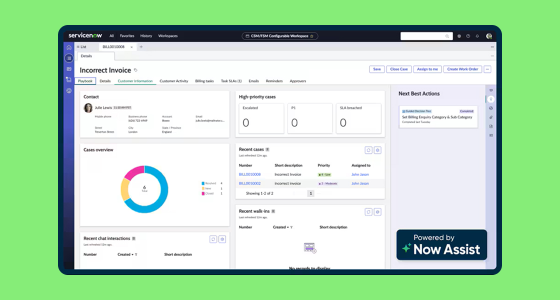
Customer Service Management should go beyond receiving cases. A proactive approach uses workflows to connect teams, enable self-service, and give agents the visibility they need to resolve issues faster and more consistently.
Financial institutions, for example, have used this model to increase self-service adoption, simplify service catalogs, and reduce development costs compared to legacy platforms.
Ticketing treats symptoms. Well-executed ITSM automation removes structural friction: it eliminates manual steps, connects teams, and makes work measurable. ServiceNow can help enable that shift with a unified platform designed to scale across departments and workflows.
If you want to talk more about this with experts: Contact us!