AI Risk Scoring in Change Management: What It Actually Prevents
August 31, 2026
A change manager approves an emergency fix at 4:50 on a Friday. The CAB reviewed it that morning, the requestor filled out every field correctly, and the rollback plan looks solid on paper. Two hours later, a dependent service nobody flagged goes down, and the on-call engineer spends the weekend tracing a failure that a complete dependency map would have surfaced in seconds. Nothing about the process failed. The people did their jobs. What was missing was the ability to see every consequence of the change before it happened, not after.
This is the gap AI-powered risk scoring and change impact prediction are built to close. Not by replacing the judgment of change managers and CAB members, but by giving them a more complete picture before they make a call that a spreadsheet, a memory, or a quick glance at the CMDB can't reliably provide on its own.
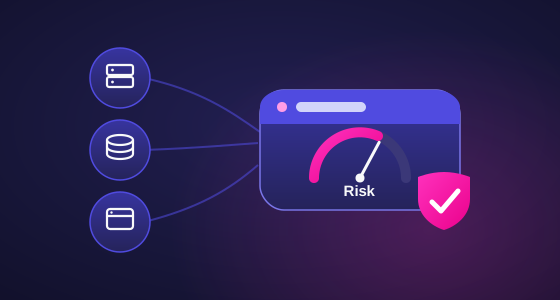
AI risk scoring is not a black box that rubber-stamps or rejects changes. It's a layer of analysis that sits on top of the data a change management platform already has: historical change records, CMDB relationships, prior incident history, dependency depth, and the specific attributes of the change being proposed. The model looks for the patterns that have preceded failures before, and surfaces a risk score and a narrative explaining what's driving it, alongside the human-completed risk assessment, not instead of it.
The distinction matters because a lot of the skepticism around "AI in ITSM" comes from imagining a fully autonomous approval engine. That's not what's actually being deployed in mature implementations. Production-grade change risk prediction requires model governance, workflow controls, audit trails, and risk explanations that a human can actually read and evaluate, which is a very different proposition than an unaccountable automated gatekeeper. The AI's job is to catch what a busy, time-constrained human reviewer might reasonably miss, and to do it consistently, every single time, regardless of how many other changes are in the queue that day.
The reason this category of tooling exists at all is that change-related failure is not a marginal problem. Depending on how the research defines "change initiative," 60 to 70% of change efforts fail to some degree, while a separate breakdown finds 50% outright failures, 16% mixed results, and only 34% clean successes. That's a coin flip at best for whether a given change goes the way it was planned.
The maturity gap between organizations is stark. Elite performers with mature change processes, automated testing, and progressive delivery see change failure rates around 5%. Low-maturity organizations see failure rates closer to 40%, according to DORA's research on software delivery performance. That's an eight-times difference in outcome, and it's not explained by elite teams having smarter engineers. It's explained by better process, better data, and increasingly, better tooling helping humans catch what they'd otherwise miss.
The outage data tells the same story from a different angle. Up to 70% of outages in live systems trace back to changes as the underlying cause. The Uptime Institute's 2025 survey found that 62% of major outages were caused by change and configuration issues specifically. Separately, 80% of unplanned outages affecting mission-critical services are attributed to people and process issues, and more than half of those are directly caused by change, configuration, or release management failures. On the network side specifically, 45% of outages trace back to configuration and change management failures, and 44% of IT teams report that network changes cause outages or performance issues several times a year, not as a rare exception.
None of this means change managers and engineers are bad at their jobs. It means the volume, complexity, and interdependency of modern IT environments have outgrown what a person reviewing a change request by eye can reliably assess, especially under time pressure, on a Friday afternoon, with three other changes also waiting for sign-off.
The Change Advisory Board exists because high-impact changes deserve human judgment, not just an automated checklist. But CABs have a structural problem that no amount of process discipline fully solves: they run on human attention, and human attention is a limited, unevenly distributed resource. A change that takes an hour to write can sit for up to 40 business hours waiting for a CAB that only meets once a week, and that delay has nothing to do with the change's actual risk level.
The deeper issue is what CAB members are working with when they finally do review a change. Without detailed impact assessments, rollback plans, and dependency mappings prepared in advance, board members can't make informed decisions no matter how experienced they are. Most CAB bottlenecks aren't really CAB problems. They're governance, readiness, and decision-authority failures upstream of the meeting itself, and a board member staring at an incomplete change record is being asked to make a risk judgment with less information than the decision actually requires.
This is precisely the gap that CMDB-driven impact analysis and AI risk scoring are positioned to close, not by removing the CAB's authority, but by making sure the CAB has a complete picture the moment the meeting starts, rather than discovering gaps in the room and delaying the decision another week.
AI risk scoring tools analyze previous deployments, incidents, code changes, infrastructure dependencies, testing outcomes, and production telemetry to estimate the likelihood that a proposed change will cause a failure, an outage, a security issue, or a performance regression. The model isn't guessing from scratch each time. It's pattern-matching the change in front of it against a large set of prior changes where the actual outcome is already known, and surfacing the factors that most resemble past failures.
Machine learning models trained this way can forecast risk and even suggest better implementation timing, enabling more proactive planning instead of a simple approve-or-reject decision. Predictive AI can identify the specific factors that historically preceded failures or disruptions for a given type of change, which lets a team take a targeted action, like additional testing or a phased rollout, rather than a blanket "let's be extra careful" response that doesn't actually address the specific risk.
None of this works, though, without accurate underlying data. Missing or broken relationships between configuration items make impact analysis functionally useless, because the model can only reason about the dependencies it can actually see. This is the direct link between AI risk scoring and CMDB health: a risk score built on a CMDB with broken or missing relationships is a risk score built on a partial picture, and it will miss exactly the kind of hidden dependency that caused the Friday-afternoon incident described at the start of this piece.
There's also an operational reality worth being direct about: production-grade change risk prediction requires more than a trained model dropped into a workflow. It requires integrations that keep the model fed with current CMDB and incident data, workflow controls that route the score to the right reviewer, audit trails that capture how a given score was reached, and continuous learning so the model keeps improving as new changes and outcomes accumulate. A model trained once on a snapshot of last year's data and never updated will drift out of sync with how the environment actually behaves today, which is the same failure mode that afflicts an unmaintained CMDB, just one layer higher up the stack.
Change impact prediction is the more specific discipline of using CMDB relationship data and historical change-impact records to forecast which services, applications, and users a proposed change will actually affect, before it's implemented, not after an incident report is filed. When this analysis runs at submission time, the requestor and the approvers see the dependency map as part of the change record itself, not as something they have to reconstruct manually from a diagram nobody's updated in eight months.
The practical effect is that implementers and approvers see the blast radius before they sign off, not after. A change to an authentication service, for example, can automatically surface every dependent application, every affected user group, and every recent incident touching that service, so the person approving the change is working from the same complete picture the incident responder would need if something went wrong, except they're seeing it before the change happens rather than during the postmortem.
Deep learning models trained on real-time CMDB data can produce genuinely accurate impact analyses, and some implementations now use domain-specific language models to flag critical issues proactively before deployment rather than waiting for a human to notice a red flag buried in a dependency list. The net effect isn't that the tool makes the decision. It's that the tool makes sure nobody has to guess at information that already exists somewhere in the environment, they just couldn't see it fast enough to matter.
The stats coming out of production AIOps and predictive change deployments are specific enough to be worth taking seriously. Organizations using predictive AIOps for trend analysis and predictive log analytics have reported preventing 25 to 35% of critical P1 outages that would otherwise have occurred. Separately, organizations report mean time to repair improving by at least 30% after implementing AIOps-driven tooling, and 81% of organizations using AIOps report a positive return on investment from the deployment.
On the CMDB side specifically, AI-assisted tooling is reported to reduce CMDB administrative effort by up to 60%, which matters directly for change impact prediction, because that administrative burden is exactly what causes CMDBs to drift out of date in the first place. An under-maintained CMDB isn't just an asset management problem. It's a change management problem, because every impact prediction and every risk score inherits whatever accuracy the CMDB actually has that day.
These numbers describe a category of tooling that's demonstrably reducing incident volume and repair time in live production environments, not a speculative capability still waiting for its first real deployment.
None of this replaces the CAB, and none of it should. The AI-generated risk assessment is designed to sit alongside the human-completed one, giving approvers a second perspective grounded in historical evidence rather than a single automated verdict they're expected to accept without question. A model can tell you that a change resembles a pattern that failed before. It can't tell you whether your organization has a business reason to accept that risk this particular week, or whether the person who wrote the rollback plan actually tested it.
This is also where explainability stops being optional. A risk score without a narrative explaining what's driving it is not useful to a CAB member who has to justify a decision to an auditor six months later. The tools worth adopting produce a risk narrative alongside the score: which factors matched historical failure patterns, which dependencies are involved, and what the model is actually basing its assessment on. That transparency is what turns an AI risk score from a number nobody trusts into evidence a change manager can actually stand behind.
Halo's approach to this problem builds directly on the change management foundation already covered in Frictionless Change Management with HaloITSM, which lays out how standard, normal, and emergency change types route through appropriately-scaled approval workflows tied to the platform's CMDB, incidents, and assets. The AI layer extends that same foundation rather than replacing it.
Halo AI analyzes every change request against historical data, CMDB relationships, and service impact patterns to generate an automated risk score and a plain-language risk narrative. Change managers and CAB members see this AI-generated assessment displayed alongside the human-completed risk assessment, which is precisely the second-opinion model described above rather than an automated override of anyone's judgment.
Change impact prediction works from the same underlying data: Halo AI uses CMDB relationship data and historical change-impact records to predict the likely effect of a proposed change on services, users, and dependent systems, and surfaces that prediction directly within the change record during the assessment stage. This depends on the CMDB relationship mapping already covered in What Is a CMDB, and Why Is Yours Probably Out of Date?, since an impact prediction is only as reliable as the dependency data feeding it, which is exactly why CMDB health and AI-assisted change management have to be treated as the same problem, not two separate initiatives.
There's a third piece that's easy to overlook: a virtual agent gives end users a way to check the status of changes affecting their services and raise related incidents through a conversational interface, without needing a service desk agent to manage each individual query. During and after a change window, this keeps the people affected by a change informed without adding manual workload to the team executing it, which connects directly to the incident-deflection approach covered in AI-Powered Level 1 Incident Deflection with Halo ITSM.
The practical effect of routing AI risk scoring and impact prediction into the CAB workflow is that the board's limited time gets reserved for the changes that genuinely need human judgment. A standard, pre-approved, low-risk change with a clean AI risk score can proceed on a fast track without ever consuming a CAB agenda slot. A change with a risk score that flags meaningful dependency exposure gets escalated to full review, with the impact analysis and risk narrative already attached, so the board isn't starting the discussion from zero.
This is the mechanism behind the earlier point about CAB delays: a change that would otherwise wait 40 business hours for a weekly meeting, regardless of its actual risk, instead gets triaged by risk level the moment it's submitted. Low-risk changes move at the speed the business actually needs. High-risk changes still get the scrutiny they deserve, but the CAB is now spending its attention where the evidence says it matters, rather than treating every change identically because there was no fast way to tell them apart.
Financial institutions, healthcare organizations, and public-sector agencies across Latin America operate under audit and compliance regimes that require demonstrable evidence of change control, not just a policy document describing what should happen. For these organizations, AI risk scoring isn't primarily valuable because it's fast. It's valuable because it produces a documented, explainable risk narrative attached to every change record, which is exactly the kind of evidence an internal or regulatory audit asks for.
The combination matters specifically in this context: AI-generated risk assessments are logged alongside human sign-off, timestamped, and tied to the specific CMDB relationships that justified the risk level assigned. When an auditor asks why a particular change was approved without full CAB review, the answer isn't "someone decided it looked fine." It's a documented risk score, a risk narrative, and the dependency data behind it, all captured automatically as part of the change record rather than reconstructed after the fact from memory or email threads. For organizations balancing regulatory scrutiny against the operational need to move quickly, that auditability is often the deciding factor in adopting predictive risk tooling at all.
The specifics vary by country and sector, but the pattern repeats consistently. Banks operating under Mexico's CNBV or Colombia's Superintendencia Financiera face examiner expectations around demonstrable IT change control as part of operational risk oversight. Brazil's Banco Central holds regulated institutions to similar standards under its operational resilience framework. Public-sector agencies across the region increasingly face procurement and audit requirements that assume a documented, timestamped change history rather than a policy binder nobody has updated since the last audit cycle. None of these regimes specifically mandate AI risk scoring, but all of them reward exactly the kind of evidence it produces automatically as a byproduct of normal operation.
Before assuming your current change process is either already covering this or doesn't need it, work through a few honest questions.
If more than one of these makes you pause, the gap AI risk scoring is built to close is very likely already costing you time, incident volume, or audit readiness, even if nobody has traced it back to this specific cause yet.
Isn't this just automating away human judgment in change approval? The opposite is closer to true in well-implemented deployments. The AI assessment is designed to sit alongside the human one as a second, evidence-grounded perspective, not to replace the CAB's authority to accept or reject a change. The decision stays human. What changes is how much relevant information that human has in front of them when they make it.
How is this different from the risk scoring my ITSM tool already does? Traditional risk scoring in most ITSM tools is a manually configured point system: assign points for affected services, business hours, and a handful of static factors, then add them up. AI risk scoring instead learns from your actual historical change and incident data, which means it can surface patterns specific to your environment that a generic point system was never designed to catch.
Doesn't this require a perfect CMDB before it's worth adopting? A perfect CMDB isn't the prerequisite, but a reasonably maintained one is. Missing or broken CI relationships genuinely do limit what impact analysis can tell you, so if your CMDB has significant gaps, closing those gaps and adopting AI-assisted change management are effectively the same initiative, not two separate projects competing for budget.
Will this slow down low-risk changes with extra AI-generated paperwork? It should do the opposite. The entire point of tiering changes by AI-generated risk score is that low-risk, pattern-matched-safe changes move faster because they skip full CAB review, while the scrutiny gets concentrated on the changes that actually carry meaningful risk.
Is this only relevant for large enterprises with thousands of changes a quarter? The underlying math scales down, too. Even a modest-sized IT team pushing a few dozen changes a month benefits from the same pattern: catching a dependency a human reviewer would have missed under time pressure doesn't require enterprise scale to matter, it just requires a change that would otherwise have caused an incident.
What happens when the AI risk score and the CAB's own judgment disagree? That disagreement is exactly where the tooling earns its value, not a sign it's malfunctioning. If the model flags elevated risk and the CAB still approves the change, that's a documented decision made with full information, which is a defensible position either way the change turns out. If the CAB flags something the model didn't catch, that's useful signal for improving the model's training data going forward. Either direction, the record of the disagreement itself becomes part of the audit trail.
Change management doesn't fail most often because people aren't careful. It fails because modern IT environments have grown more interdependent than a manual review process, however well-intentioned, can reliably account for under real time pressure. AI risk scoring and change impact prediction don't remove the CAB or the change manager's judgment from the process. They give both of them the complete picture a spreadsheet and a memory were never going to reliably provide, which is exactly what separates the organizations preventing 25 to 35% of their critical outages from the ones still tracing failures back to a dependency nobody happened to notice in time.
If you want to see what AI-assisted risk scoring and change impact prediction actually look like inside a platform that ties them directly to your CMDB, incidents, and CAB workflow, book a conversation with our team. We'll walk through where your current change process is likely losing visibility, and what a more complete picture would change about your next Friday afternoon deployment.